Culinary Classes in Umbria, Italy

I came to Italy a Sous-chef and left Italy a Master chef!  Just kidding.  I’m neither a chef nor a baker, but with the amount of cooking we did at Il Colombaio, I’m certain I can get around the kitchen a little better now!

Bruschetta

Our first night at the Villa, we learned the Bruschetta making traditions in Italy, as well as how to properly pronounce the name of this tasty appetizer.

In Italy, bruschetta is grilled bread rubbed with garlic and topped with olive oil.  It is also commonly served with hummus or chickpeas, rosemary and cheese.  A third variation may be served with tomato, but this is not the primary way it is served like it is in the USA.

Pizza

In Umbria, pizza is generally made without cheese!  We had a lesson with Antonietta. After she prepared the dough, we each patted a large handful into blobs, let them rise and then hand pressed them into a rectangular pans.

Then different toppings were added to each pan which included just red sauce; just tomatoes and olive oil; onion, olive oil and rosemary; grilled vegetables; and red sauce with chunks of fresh mozzarella.

We probably threw Antonietta for a loop when we wanted to add some meat for protein, but she only spoke Italian, so whatever she thought didn’t get translated to us!

Pasta

Another day…another cooking lesson with Antonietta.  This time we made pasta. Antonietta made a big hole in a pile of flour and started adding eggs for the dough. She kneaded the dough mixture until she felt the right consistency.  Once it reached the correct consistency we rolled it out with a rolling pin.  Antonietta could make a perfect circle.  Ours weren’t quite as picturesque, but Kristi and Diana did a nice job.

With our dough, we made several types of pasta.  First, tortellini!  Antonietta had already made the pork filling (no cheese in tortellini in Italy).  Next, she cut circles of dough for us that we folded in half with filling, wrapped the half circle around our finger, pinched the ends together and then folded over the cap.  It was easier to make than I thought!

Then came crescent shaped ravioli that we closed together with the tongs of our fork. We already had good practice with filling the tortellini, so this was a quick success.

Antonietta continued with cannelloni.  She cut rectangles out of the dough and flash boiled it for ten seconds or less.  Only salt is added to water to boil pasta in Italy…no oil!  Also, the pasta is generally scooped out of the boiling water and is never rinsed. Antonietta scooped the rectangles out of the water.  We patted them dry, added ricotta cheese, and rolled them into a cylinder to make the cannelloni.

After cannelloni, we made tagliatelle.  Tagliare means to cut in Italian.  As such, tagliatelle is hand cut.  It is not run through a pasta cutting machine.  A circle of dough is folded on top of itself from two “sides” if circles have sides, so the result is a long, rectangle of folds.  Then, the dough is sliced thinly, lifted from the middle, and swung into a round cluster.  Antonietta could do this in seconds.  We took minutes! Regardless, it was fun, and it was a tasty dinner.

Crostata

Paola has a special recipe for cherry crostata.  She taught us how to make it.  The secret ingredient was cinnamon.  Once she made the dough, we pressed it into individual pans, added cherry preserves, marked our desserts with a distinguishing deocration, and brought them upstairs to be baked. Guess which one is mine!

Tiramisu

Irma is one of the folks who owns and runs Il Colombaio.  We got to learn from her mother, Anna, how to make Tiramisu.  What surprised me the most was to learn the meaning of Tiramisu…”lift me up” or “pull it up”.  It was served to clients in brothels to invigorate them!  I didn’t know that, but it was fun to hear as we learned how to make the dessert.

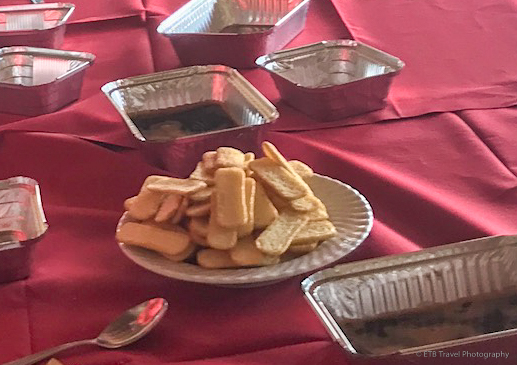
First we made mascrapone cream by hand stirring in the same direction mascarpone, egg yolks and sugar.  Then we carefully folded in stiffened egg whites.  Next we spread a little mascarpone cream on the bottom of the pan.  On top of the cream, we layered lady finger wafers briefly dipped in coffee.  On top of the wafers, we added more cream and a sprinkle of cocoa.  After three layers of lady fingers, we finished off our tiramisu with distinguishing decorations to tell which dessert belong to each person. Because of the meaning of tiramisu, I put lady fingers in a form of penis!  ETB


Tastings in Tuscany!

all we do is EAT in Italy

Well, it’s diet time…For American’s I think Tuscany translates to indulgent dining.  And when we weren’t savoring three course meals, we were tasting truffles, olive oil, cheese, and wine!

Truffle Tasting

Truffles…YUM!  I LOVE them, so I was very excited to visit Doriana, a truffle expert in the region.  Doriana, who has a store full of everything truffle, including sliced, diced, spread and mixed with other vegetables, buys her truffles by the pound from regional farmers who bring them to her store.

The farmers use dogs, generally mutts who have a good nose to hunt for these treasures which can be found a few inches or a foot underground during the spring and the fall.  The white truffles are more rare than the black truffles as they only grow in October.  While the farmers are always out searching with their dogs which can be worth thousands of dollars, many times the best time to find the truffles are during a full moon!

Doriana greeted our group of ten graciously.  A table was already set with plates of breads with a variety of spreads including plain truffles, truffles with asparagus, and truffles with olives just to name a few.  We learned which spreads or sauces would taste best with pasta or topped on a ribeye.  Of course, in typical Italian fashion, we washed down our nibbles with wine and expresso!

At the end of the tasting, none of left empty handed.  We all had a few jars of rich, tasty truffles to savor back in the States.

Olive Oil Tasting

It’s amazing how inexpensive olive oil is in Italy!  Too bad Rita didn’t ship, or our group of ten may have bought her out of the varietal olive oil gift pack.

Generally, olive oil is made with a blend of different olives; black, green and red.  Rita had an idea to make varietal olive oil in order to taste the flavor of each type of olive. She planted her olive trees fifteen years ago, and is the only one our tour guide knows of who produces both a blend and varietal olive oil.

We got to enjoy the afternoon at Rita’s operation.  We wandered through her olive groves, picked perfectly ripe figs right off the trees to eat with our picnic lunch, and admired the lovely views while also learning about her olive oil endeavor.

Cheese Tasting

Our sheep farm visit was very interesting!  Sheep in Italian in pecora, as such today were learned how to make pecorino cheese.

The sheep farmer we visited owns 1,000 sheep.  There are two seasons…breeding season and milking season.  The milking season lasts for five months.  Each female sheep produces a 1/2 liter of milk twice day.

To make the cheese, a 100 liter vat is filled with milk that is mixed with enzymes, bacteria, and any flavor like truffle or pepper.  The mixture is squirted into baskets which are placed on a tray which is moved into a warming storage room where the cheese ferments.  After about twelve hours, the cheese is moved to a cold storage room to stop the fermenting process.

The following day, the aging process begins.  The cheese may be aged for months or over a year.  Some of it is packed in walnut leaves or grasses to add different flavors.

After learning about the process, we were invited into a tasting room where we tried a fresh cheese, eight different aged cheeses, and ricotta mixed with sugar for dessert. Most of us ended up liking a six month old aged cheese.  It was quite a tasty and fun lunch!

Wine Tasting

Cantina Murogrosso was just a quarter mile down the road from our villa, so we walked to the winery for a lovely tasting with Paola, the sommelier but also an assistant to our tour guide.

The grapes were just harvested (early due to the drought), and we arrived just in time to see them working with the giant tanks of grape juice, soon to be wine!  The winery is expecting a good year.  With the drought, the grapes weren’t plentiful, but the quality of the grape was excellent.

After wandering through the vineyard, we made it to the tasting room.  We tasted two whites, a rosé, and two reds with breads, cheese, and meats.  Paola advised us to save the rich cheese for the rich red wine.  We also learned that it is important to hold the stem of the wine glass as not only do our hands warm the wine, but the oils from our hands can transfer through glass which can change the flavor of the wine.  She is not a fan of stemless wine ware!

In addition, the rich red wine needed to breathe for at least two hours!  I really enjoyed the full-bodied red wine that included the same type grapes and blend of a Brunello though it could not bear the name as the vineyard did not fall in the specific region.

Cantina Murogrosso is small winery and produces only about 8,000 bottles a year. They hand pick all their grapes which means humans are choosing the best grapes and pruning them before they are placed in the bucket.  Large wineries which use machines, mix together all the grapes, mold, bugs and more!  By hand picking the grapes, they don’t have to add as many chemicals to kill all the bugs, bacteria, and mold either.  In addition, since they don’t commercially ship to the USA, they aren’t subject to all the sulfite requirements.  As such, I could drink a whole glass without getting a headache.  What a fun evening!

Shop

Check out the photographic note cards and key chains at my shop.  Each card has a travel story associated with it.  20% of proceeds are donated to charity.

photographic note card, camellia
CAMELLIA
Best Adventure Travel Blog
wines of montepulciano

A Day in Montepulciano, Italy

A Girls Trip to Tuscany

My tennis partner Ann organized a girls trip to Tuscany.  Ten of us came from near and far.  Some arrived in Italy early; others arrived the day we were transported to Tuscany from Rome.  With the exception of Mary, most of us enjoyed a smooth arrival to Rome not counting the deluge of water falling from the sky!

We took two vans to Il Colombaio, our villa on the border of Tuscany and Umbria. We settled in for a lovely evening of food and drinks and prepared for our first full day in Tuscany in Montepulciano.

Montepulciano is a medieval and Renaissance town that sits atop a 2,000 foot limestone ridge in southern Tuscany.  It is renowned for its pici pasta and Vino Nobile wine.  Our drivers delivered us directly to its Piazza Grande formed in the typical medieval fashion with a church, the city hall, and a wealthy man’s residence with a portico below for socializing and doing business.  On a side note, the FREE public bathrooms were nearby (a nice change from the Amalfi Coast).

The church which borders the square is called the Cathedral of Santa Maria Assunta and is also known as the Duomo of Montepulciano as it is the most important church in the town.  Here is a link to an interesting article discussing the difference in Italian Church names:  chiesa, basilica, catedrale, and duomo: Is it a church or a cathedral?

After looking around the square, we visited Rameria Cesare Mazzetti.  Rameria means copper smith, and Cesare is a famous one.  He hand makes a variety of copper kitchen ware and decorations.  His craft has been passed down through his family for generations.  He still uses his grandfather’s stamps and tools today which are over 100 years old.

Cesare buys his copper from Chile.  It is certified in London and is then sent to Italy. He receives it in forms of rough globs and thin sheets.  He hand pounds the copper into the appropriate shape and depending on its function adds pure tin.

While copper requires a little more attention in the kitchen, it offers distinct advantages and professional chefs from around the world commission work with Cesare.  Both the shape and the thickness of the copper is very important for the pots to transmit both high and uniform heat for cooking.  In order to withstand the heat, the pots require the correct number of beats with the hammer!

In addition to being excellent heat conductors, copper also adds iron to water, so those who are anemic can add cold water to a copper pitcher and eventually get the iron they need without taking medicine.

Cesare was quite the character and a rather horny old man.  He wanted a kiss from every lady after he pretend branded everyone’s buttox before we left his laboratory to see his store up the street. As a parting gift, we made a copper decoration with flower petals, our initials, and the date. It was nice and creative!

After visiting his store, we wandered the streets of Montepulciano.  The views of the rolling Tuscan hills covered in olive groves and vineyards were lovely.  I wandered around the town looking for interesting photos, while the shoppers in the group visited the row of stores to find some nice leather, jewelry, and olive wood cutting boards just to name a few items purchased.

Many of us also explored the Città Sotterranea.  Here we weaved through passage ways filled with giant barrels of Vino Nobile produced by Ercolani.  The underground city included a crypt, the well of love, old olive crushing equipment and combs used for sheeps’ wool.  I loved wandering through the maze of rooms.

After the morning in the walled town, our drivers provided a short ride to Ristorante la Grotta, a Michelin Star restaurant located at the base of the town across from the Chiesa di San Biagio.  Courtesy of Ann, we enjoyed a long, savory lunch before heading back to the villa where we took an afternoon walk through the Tuscan hillsides before we ate and drank the night away.  ETB

At the Villa

WANT TO TAKE THIS ARTICLE WITH YOU?  DOWNLOAD IT HERE WITH THIS GPSMyCity TRAVEL APP LINK:

A Day in Montepulciano, Italy

Three Days in Sorrento, Italy

If you only have three days to spend on the Amalfi Coast, I recommend staying in Sorrento as it is a very good central location for seeing the area.  Having said that, if you are looking for rest and relaxation on the coast, three days is not enough time.  I recommend staying at least week midway along the Amalfi Coast so that you can avoid the crowds and visit the popular towns in the evening when the masses have gone home for the day.  I thought I was going in the off season during September, and compared to August, apparently I was, but it certainly felt otherwise.  This is what I learned during my time in Sorrento and on the Amalfi Coast.

How to Get to Sorrento

It’s likely easiest to fly into Naples to eliminate two train rides, but the airline pricing from the USA encouraged me to fly to Rome.  From Rome, it takes three train rides to get to Sorrento, but it is the most affordable route.  The first is the Leonardo Express train, a non-stop service between the airport (FCO) and Roma Termini (the main station). The train departs every half hour from 6:23 to 23:23, and the trip takes 32 min.

Once at Roma Termini, purchase a ticket at one of the many kiosks (self-explanatory) to Napoli Centrale. There are a few train options. I used trainitalia.  The high speed train takes 1.25 hours.  The ticket prices vary based on car class are lower if purchased in advance online.  Second class is perfectly comfortable.  The reserved seat and car number are printed on the ticket.  The train can be very full depending of the time and date of travel.  I chose to wait until I arrived to purchase my ticket just in case my flight was delayed, and rode a somewhat empty train to Napoli on Wednesday, but my return train on Sunday was completely full.  I felt lucky to get a ticket on same day travel.

At Napoli Centrale, go downstairs to Napoli Garibaldi (same station, different name). Catch the Circumvesuviana train for a few euros.  This train was not air conditioned and was standing room only for most of the ride.  I had considered not taking it due to all the cautions I read about being pick-pocketed, but I didn’t have a problem, and never felt threatened.  I’d just say be aware like any savvy traveler.  This train also leaves every half-hour and takes between 45mins-1.25 hours depending on if it is “directo” or “directisimo”.  Here is the train schedule.

Should the cramped and hot quarters be unappealing, a ferry service is available, but that required an extra step for me…a taxi ride from the station to the port and then the high-speed ferry.  This is a helpful website for ferry travel: http://www.italylogue.com/featured-articles/how-to-get-from-naples-to-sorrento.html

Where to Stay in Sorrento

On my first day in Italy, although exhausted, I forced myself to tour around.  For some reason, I expected a quiet coast like Cinque Terre.  This was not the case!  Of all the places I’ve been, I was most scared to step into the crosswalk in Sorrento especially after noticing virtually every car had a scrape on its front or back fender.  Pedestrians regularly had to play chicken with vehicles, though the drivers did stop.

I stayed at Relais Villa Angiolina which was conveniently (and I suppose when I was entirely exhausted inconveniently) located a short distance UP the hill from the old town of Sorrento.  The hotel is like a quiet oasis in the middle of the hectic city and features a lovely garden.  My room was fine, nothing too exciting, though I was surprised to find gel packets for “intimate hygiene” along with the shampoo!  I enjoyed a nice breakfast everyday on my patio which was included in the price of the hotel, and the staff was simply wonderful.

Places to Eat in Sorrento

On Wednesday, both hungry and tired, I followed the map to the main street which led me to Piazza Tasso, named for poet Torquato Tasso.  The traffic zips around the Statua di S. Antonino as tourists order food and drinks at one of the handful of “bars” lining the street.  The meals at these places are over priced and not the greatest, a perfect tourist trap, but it kept me from wandering aimlessly while jetlagged on no sleep!  I got the shrimp special at Fauno Bar, and I think there was a reason why it was a “special”, but at least I got a free Limoncello at the end of the meal.  In addition, the service was fast and friendly.

Places to Visit in Sorrento

After lunch, I wandered around some more to get the lay of the land.  I strolled by Piazza S. Antonino complete with a strange statue as I continued along Via V Veneto to Piazza Della Vittoria where I enjoyed lovely views of the sea before I turned left up Via T Tasso and poked my head into Chiesa di San Paolo, a lovely catholic church on the way back to the hotel for a short rest.

I mustered up the energy to go out for dinner later.  I weaved around the mobs of people shopping on Via San Cesareo, bounced around a few side streets and finally settled on Ristorante Sorrento.  The prosciutto wrapped melon was ok.  The pasta main course was excellent.  The service, once again, was fast!

The next morning, I planned a tour along the Amalfi Coast and the pick up location was at Hotel Antiche Mura.  I gave myself some time extra time to find the hotel and slowly picked my way down Corso Italia while checking out the Duomo e Campanile, an 11th century cathedral with a lovely three story clock tower.

Upon arrival at Hotel Aniche Mura, I found it sitting atop a gorge where the ruins of Il Vallone dei Mulini stood below.  It was quite an amazing scene in my opinion. Of course I like mills and old buildings and wanted to get down there to see it up close. I asked the way, but there wasn’t one.  I could just admire it from above.

After my tour along the Amalfi Coast, we returned to Sorrento in a massive down pour!  I donned my raincoat and rushed down the shopping street, now almost vacant from tourists as they had taken cover from the rain.  I had seen a restaurant that looked popular the previous day and was aiming for dinner there, but I couldn’t remember exactly where it was, so now that I was completely drenched as I came upon a top 10 restaurant according to TripAdvisor, Ristorante Fuoro.

Chilled to the bone, I ordered mushroom soup for an appetizer.  Since the Amalfi Coast is known for its fish and lemon, I tried this for the main course.  Unfortunately, the restaurant was out of the soup and when my second bite of fish included four bones, I started picking at it.  Despite scraping my fork across the filet, I still ended up with two more bites of bone.  This just about did me in…as a child I would have stopped at the second bite! Based on the restaurant’s ranking, I must have ordered wrong!

The next day took me on a boat ride tour to Capri and afterward I decided to explore some more nooks and crannies in Sorrento.  The more time I spent in the town, the more I liked it.  Tonight I walked to Marina Grande via the Porta Romana, a cool old arch.  I ate at The Five Sisters Restaurant, where according to the sign, Sofia Loren recently dined.  I went with pasta and clams caught by the local fishermen.  The meal was fantastic!  The people next to me loved theirs as well.  In addition, the pricing was more reasonable, though it was cash only.  I was surprised to see it got panned on TripAdvisor, as it was the best meal I had the whole trip.  In addition, I got to enjoy a wonderful sunset.

My Rick Steve’s info claimed the best gelato around was at Davide il Gelato.  There is also Gelateria David, so it’s best to know the difference.  While I prefer chocolate, the gelateria is known for its fruit flavors, so that is what I tried.  It was quite tasty.  I walked off dessert by walking down the countless steps to Marina Piccola.

My final day on the Amalfi Coast was in Pompeii.  After visiting the ruins, I returned to Sorrento and found three more places to explore. With the exception of seeing Bagni della Regina Giovanna, a secluded swimming hole, I feel like I really covered the city.

I wandered to the other side of town to visit I Giardini di Cataldo.  It was cool to see the vats of Limoncello, but other than that I didn’t see the draw to make it the #12 place to go in Sorrento.  After visiting the lemon garden, I walked to Chiesa e Chiostro di S Francesco.  I had visited the night before, but it was very dark, so I wanted to see the church again.  This time I happened upon an Italian wedding.  How cool is that?!?  I assume the priest announced, “I pronounce you husband and wife” as everyone clapped, but then he kept talking and when the ceremony ended just a minute or two later, the crowd began trickling out, but the bride and groom stayed near the front of the church with their family.  That was different from what I’m used to seeing!

Finally I had dinner at Gigino, a restaurant in the old town district whose patio was always full.  This time I ordered pizza since Napoli is known for it.  The atmosphere was nice and the pizza was good.  I’d go back, but I liked the Marina Grande area better.  Overall, Sorrento was a great town!

Day Trips From Sorrento

Amalfi Coast

My first day trip from Sorrento was along the Amalfi Coast.  I used Mondo Guidewhich is associated with Rick Steves.  They used two small vans that held seven people each to take us to Positano, Amalfi, and Ravello.  The pick up location was at Hotel Aniche Mura.  They were timely and professional.  If only the family I was paired with was too.  The family included two adults who lived in the area, two who lived in Panama City, and two who lived in Florida.  They were late for departure and then the local gentleman proceeded to conduct business calls, one of which was on speaker phone through out the car ride, which wasn’t terribly enjoyable to hear.

Vincenzo was our driver.  When we first began the tour, the winding road which followed the coastline of the Salerno Gulf on the Tyrrhenian Sea, didn’t seem to hard to drive ourselves.  The traffic wasn’t too bad, there were scenic view pullouts along the way.  In addition, Vincenzo could point things while driving.  Once we arrived in Positano, our first visit, that changed!  Boy was I glad I had paid for a driver.  Due to the limited and expensive parking, cars were parked along the narrow road for at least a mile!

Fortunately for us, Vincenzo brought us right to town, parked by the gas station, and then pointed us to the pedestrian only shopping area.  Fancy shops lined the slim corridors that veered in a variety of directions downhill toward the rocky beach. Tourists browsed the shops while I squeezed between them in search of a more peaceful area.  Surprisingly, after reaching the beach, I found a path to the right (or west) with a sign indicating a hotel.  Being lazy, I almost didn’t take it as it slanted upward, and since all I had done for the previous week was climb up and down mountains, going up another incline didn’t appeal to me.  Just walking down all the stairs to the beach was enough!

Anyway, we had an hour in the town, and I covered the shopping area and church in less than a half hour, so what else was I going to do?  Off I went.  I only passed a few visitors as I meandered along the coastal trail which eventually led to another beach guarded by an old fortress, now private, so I couldn’t go near it.  The walk provided lovely views and due to the cloudy, cool weather, the beach was empty, so it was a very tranquil place.

Soon I returned to the gas station, met the group, and Vincenzo steered us through some small towns to our next stop, Amalfi.  Along the way, we contended with huge buses that hardly had room to pass each other as they inched forward and backwards to pass without scraping sides.  Cars had to move out of the way by reversing or going around.  At times, there were also traffic stops.  I’d hate to see this place in the summer, as a weekday in September was busy enough!

Amalfi

In Amalfi, Vincenzo parked down by the water, we crossed the main highway and entered the old town.  One of the first things that comes into view is the Amalfi Cathedral.  There was an entrance fee and pictures weren’t allowed, so I boycotted going inside.  I don’t mind an entrance fee, though it seems a little sketch for churches to do this, but if I can’t even take a picture for a memory after I paid, I don’t see the point!  I carried on to the Museo della Carta on the outskirts of town.  I had to shimmy between window shopping tourists and cars zipping by on the tight road.

I over heard a couple say, “You know that lawyer in Chicago that filed the lawsuit for the bus running over someone’s foot, he’d make a fortune here!”  It was true.  I’m amazed more people aren’t struck by moving vehicles.  So the paper museum was ranked in the top five things to do in Amalfi by TripAdvisor. I paid four Euro, walked through a library and into a room filled with some old paper making equipment before exiting around the back to see a water trough and completed the tour in about four minutes.  I was shocked to find this was ranked in the top five things to do in Amalfi.  I suppose it was a testament to the size of this small town…there is not a whole lot to do!

I returned to the main drag and dodged more cars and tourists by taking detours on to small sidewalks which led up to residences.  I do like to weave through the mazes of side paths.  Finally, at the suggestion of Vincenzo, I tried the Cuoppa d’Amalfi, a paper cone of fried seafood.  I got one with fried squid and fried shrimp. I loved the overly salted squid.  The shrimp tasted a bit “shrimpy” to me, so I am 0 for 2 on shrimp now. Perhaps my tastebuds have changed.

Ravello

From Amalfi, we headed to Ravello which wasn’t too far away.  Vincenzo parked below, and we climbed the stairs into the square.  Ravello was a much smaller and quieter town that I LOVED.  It was much more my speed.  Vincenzo gave us two very good suggestions.  First, he said to walk past the archway where the concerts are held in the park because the view of the sea is the same, and there is no admission fee just 40 meters away.  He also suggested we go to Villa Cimbrone, a posh, old world hotel with fine dining and lovely gardens.  The walk through small alleyways past the Monastery was charming in and of itself, and the eight euro entry to the gardens was well worth the solitude.

The Cloister, adorned with interesting artwork and sculptures and the Crypt are to the left of the entrance   A long walkway covered in vines led visitors to the Statue of Ceres located beneath a pavillion marking the entrance to the Terrace of Infinity.  The natural balcony adorned with eighteenth century marble busts provided magnificent views of the multi-colored coastline.

I continued following a path which took me past additional statues tucked in the shade of oaks, alder and chesnut trees.  Soon I reached a lovely rose garden before I finally headed back to the square.  From the square, I took a short walk past the small row of shops before I joined the tour ride back to Sorrento.

Day Trip to Capri

My second day trip was to Capri.  I also booked this through Mondo Guides who contracted with Capitano Ago.  If swimming and riding a boat around the island and through the famous Faraglioni Rock formations is the goal, then this is the appropriate tour as it is limited to twelve people.  Having said that, the crew seemed to care more about their boat than their passengers, and I would not use them again. If seeing both Anacapri and Capri in addition to going to the Blue Grotto is first priority, then I recommend joining the masses on the ferry for half the price of the tour.

I picked this tour for less people, the ease of seeing the Blue Grotto, and for seeing both towns.  I knew that high tides could keep us from entering the Blue Grotto, so I asked at booking time if the tour was timed appropriately for the tides.  I was informed the tour doesn’t go in bad weather.  As such, when they switched my tour date from one day to another, I was under the impression the Blue Grotto was open. It wasn’t due to high tides.  I felt somewhat bamboozled.

Once on the island, four hours was not “plenty of time to visit both Capri and Anacapri” as the brochure claimed, so don’t make my mistake! Regardless, I tried to absorb as much in a I could.  I skipped through the town of Anacapri before riding the chairlift up to the top of Mount Solaro for panoramic views.  I took the path down, stopping to admire and old church and other ruins.  I quickly paid for the bathroom (which was a common and annoying theme in Amalfi – nickled and dimed for everything including “free” bread on the table which isn’t free), and then joined the bus line which fortunately was only took 15 minute.  It can be much longer and the taxis are a fortune, 25 – 40 euro for a ten minute ride.

I made it to Capri in time to get lost wandering through one narrow corridor and to take in the view from the square before I had to ride the bus again back to the marina to reload the boat.  I missed a variety of things in Capri which was disappointing, but at least I saw most of Anacapri which was also less busy.  Had I known the Blue Grotto would be closed and it took longer than the advertised four hours to see the two towns, I definitely would have booked the ferry.

Pompeii and Vesuvius

My third and final day trip from Sorrento was to Pompeii and Vesuvius which was an easy train ride away on Circumvesuviana.  It took about 30 minutes to get to Pompeii and cost just a few Euro.  Upon arrival at Pompeii, there was a public bus departing to Vesuvius.  I paid the roundtrip fare to the bus driver, just under 7 euro and took a 45 minute bus ride to the ticket office at the top of a very winding road to Vesuvius.  The buses actually honked before entering the narrow blind turns to notify traffic oncoming traffic of their location.

I purchased a 10 euro ticket to the volcano that literally blew its top in AD 79 spewing stones, ashes and molten rock on Pompeii and Herculaneum.  While the eruption destroyed the villas, many of the artifacts were well preserved due to lack of air and moisture.  I was very excited to climb Vesuvius as volcanoes have always been fascinating to me, mostly because I’d like to see lava just once.  I followed the path to the top of the crater’s rim after an early stop to enjoy the only view of the densely populated coastline before I entering the low clouds.

The nice part about Vesuvius is the ability to walk around the rim.  The disappointing part is that it was enveloped in clouds, so it was hard to see anything at all. Additionally, the whole hike which was rather leisurely while taking pictures of white fog took less than hour.  Having previously been to the rim of a volcano, I’m not sure the ride over, waiting for the next bus pick up, and the ride back which took three times longer than the hike made it worth the visit, especially after I learned I missed going into the most preserved house in Pompeii by ten minutes!  Just something to keep in mind if tackling both sites in a day.

Anyway, on to Pompeii.  The bus driver asked me if I wanted to be dropped off at the train station or the ruins.  I said the ruins.  What I didn’t realize is that there are two entrances, the main one which is up the stairs from where I was dropped off and closer to the train station, or another nondescript one across the plaza from the road. The line was short at this entrance. I’m unsure if that was because it was a secondary entrance or because of the late hour (after lunch) which I understand is when the crowds dwindle.  While I enjoyed the quick entry after I pointed out to cashier she charged me for two on my credit card (I’m not sure if that was an error or not given she gave me cash back), I made two mistakes.  I forgot to ask for a map which I highly recommend having as Pompeii is basically a large maze!

Secondly, I was following the free guided tour by Rick Steve’s which is available online and it assumes entering through the main gate.  As such, not having entered the main gate, I was somewhat lost!  Fortunately, I had grabbed a tiny map from my hotel room, so I used it to steer me toward the main area.  I managed to find the Forum which was the fourth stop on Rick Steve’s tour and where I started.  I basically missed the main entrance and the main street, both of which I found later.

The Forum was the commercial, religious, and political center of Pompeii.  The Temple of Jupiter where people came to make offerings, marked the North end of the square. The City Hall stood at the South end.  The court house, with some stumpy columns remaining, could be found on the West side.

Before leaving the Forum, I checked out some of the artifacts in glass enclosures.  It’s amazing to think volcanic debris both destroyed and preserved this ancient Roman town that was rediscovered in 1748 by the Spanish military engineer,  Rocque Joaquin de Alcubierre.  What’s creepy is to realize the ash also preserved the very humans it killed!  The bodies decomposed leaving hollow spaces which were filled with plaster by archaeologists while excavating.  The last minutes of these peoples’ lives can be seen with the casts…incredible.

From the Forum, I headed to the baths, just past the modern cafeteria.  The baths have a men’s and women’s section.  After working out in the “gymnasium”, clients took a hot, warm, or cold bath.  The engineering of the bath house was impressive.  In the hot bath, or steam room, the floors were heated!  The fountain spilled water onto the floor, creating steam.  The ceiling included ribbing so that the condensation didn’t drip on patrons.  Who knew heated floor existed in 600 BC!

Across the street from the baths, were fast food joints!?!  Marble counter tops with holes for pots that contained food are still there today.  Apparently Romans didn’t cook much in their tiny apartments.

The next stop, just up the street from the fast food joints was the House of the Tragic Poet.  It wasn’t open, but visitors could still look through the glass into the entry hall. It didn’t seem like it was open often.

I returned past the fast food places to a giant arch which was part of Pompeii’s water delivery system.  A long aqueduct brought water to the city, but because the water pressure was poor, substations like this arch were constructed.  Its water tank was hidden atop the arch!  The aqueduct fed water to three independent systems…the bath houses, private homes of the wealthy, and neighborhood wells.  In the event of a water shortage, water was cut off to the bath houses first and homes second.  The fountains remained operational so all citizens could get water for cooking and drinking.

From the arch, I continued to the House of the Faun, Pompeii’s largest home.  With 40 rooms and 20,000 square feet, it covers an entire city block!  It is famous for a small life-like bronze and the floor mosaic of the Battle of Alexander.  Alexander is the only one without a helmet.

From the House of the Faun, I headed to the House of the Vetti, the most preserved house in Pompeii.  The sign at the door made it seem like it was open every day until 1:30.  What a bummer to just miss going inside.  I did get to look through the doorway of the bachelor pad to at least see a fresco in the entryway which featured a large erection.  The penis and the bag of money balance each other on the gold scale above a large bowl of fruit.  The meaning is: Only through fertility and money can one enjoy true abundance, the fruit.  The pool in the atrium, which I could also see, served as a water supply tank.

I continued on to a bakery mill which had flour grinders and a brick oven and a tavern before finally reaching a brothel or lupanare…there were several of each in the town. The brothel included several small rooms with stone beds and pillows. Above each door were painted frescoes possibly indicating different services rendered.  The prostitutes were always painted with white skin as this was considered beautiful. Prostitutes were known as lupa or she-woman for the call she made (like a howl) to attract business.

After visiting the brothel, I made my final stop at the theater, built into the hillside by the Greeks as Pompeii, an ancient Roman City, was founded by the Greeks and Etruscans around 600 BC.  The theater, which could seat 5,000 people, sat next to the Gladiator barracks and courtyard where the warriors practiced.  This is actually where I entered Pompeii.  Instead of leaving this way, I looped back to the main drag, wandered once more through the Forum, and then left by the Entrance as I finally had my bearings.

On the main drag, the basalt stones of the streets were the original Roman pavement and the sidewalks were raised to hide the plumbing.  The large stepping stones that crossed the streets let pedestrians get from one side to the other without stepping in the flooding water that the Romans used to clean the street.  Chariots, with standard sized axles, could straddle the stones and their wheels have left grooves in the pavement.  A street with one stepping stone was one-way, a street with two stepping stones was two way, and a street with three stepping stones was a major thoroughfare.  Three tall stones were traffic barriers which allowed for a pedestrian shopping mall.

a one-way street with grooves from the chariots

Pompeii was well worth the visit and the crowds were manageable.  I hear, however, Herculanean is very well preserved too with less visitors.  Herculanean is a longer train ride from Sorrento, but easily reached on the Circumvesuviana.  After about three to four hours in Pompeii, I was too tired to continue to Herculanean and returned to Sorrento for a quiet evening before heading to Tuscany for the next week.  All in all, I’m glad I visited the Amalfi Coast.  I was expecting it to be more relaxing, but that requires a longer stay!  ETB

Want to Take This Article with You?

Download it here with this GPSMyCity Travel App Link: Three Days in Sorrento, Italy

Shop

Check out the photographic note cards and key chains at my shop.  Each card has a travel story associated with it.  20% of proceeds are donated to charity.

photographic note card, old pier in florida
OLD PIER
Best Adventure Travel Blog
sausage in madrid

18 Hours in Madrid…Mostly Dining!

Traveling to Madrid

Where To Stay

Getting to and from Morocco from the USA wasn’t that easy.  We opted for an 18 hour layover in Madrid, and enjoyed an afternoon and evening of dining.  Suman found a great hotel called Petit Palace just off the Plaza Major.  This hotel was in a prime location and only $96.  The vibe was modern, and it included everything we needed including a view of the city from our top floor room.  We were not staying long enough to take advantage of the bikes or the free walking tour, but these are great amenities. We dropped our stuff and went in search of lunch as Iberia ran out of food for purchase for those in the last rows of the plane.  They had some items, but not what we wanted.  Anyway, we were hungry.

Places to Eat

Casa Gonzalez

Suman had a place in mind from TripAdvisor called Casa Gonzalez.  They served lots of cheese and meats as well with breads with spreads.  Since they were known for their breads with spreads, I ordered an artichoke spread.  It was mostly bread with little spread.  I think Suman’s choice of a charcuterie plate was a much better option.  It was good, but I wished for more tapas varieties especially after our phones took us around in circles as we hunted for the quaint restaurant.

Plaza Mayor

We took a much shorter and more direct walk back to the hotel as we passed through several plazas, including Plaza Mayor.  The Plaza Mayor was built in 1617 during the reign of Philip III, is the central plaza of Madrid, and is surrounded by three-story residential buildings.  The centerpiece of the plaza is a bronze of King Philip III.  I expected it to be more crowded, but judging by all the tables outside of the restaurants, I feel like at night it would be very busy.

Mercado San Miguel

Fernando, our guide in Morocco, suggested we check Mercado San Miguel, which was practically across the street from our hotel.  We wandered through to get an idea of what was available, and we found just about every food imaginable…meat, olives, seafood, paella, tarts, and nuts, just to name a few.  It was crowded with a nice vibe. All the tables in the center were taken.  It was standing room only.  Not currently hungry, we just stopped at the Sangria stall.  We had a choice of sangria on tap or from the bottle. Then we got to choose white or red and traditional or not.  At the recommendation from the gentleman behind the counter, we sipped a glass of non-traditional red and enjoyed the complimentary olive snack for a bargain price. Wine and olives are a steal in Spain!  Mercado San Miguel was so enjoyable, we decided to come back for dinner.

Mesón de la Guitarra

Back at the hotel, Suman checked Facebook and saw one of her friends suggested we go to Mesón de la Guitarra, also around the corner from the hotel.  The cave like atmosphere looked cool, so we decided to start there.  Wine for $2 in a cup was a nice start.  I got to order a potato omelet which was awesome.  We also got some peppers and fried calamari.  These tapas plates were quite large, so we didn’t leave any room for food from Mercado San Miguel, but we walked through once more because it was a cool, energetic place!  I sort of wish we stuck with our original plan to have dinner at Mercado San Miguel, but I don’t think I would have found a better potato omelet than the one we found at Mesón de la Guitarra.

We had to leave by 8:15 in the morning.  This is apparently early for Spanish standards as the coffee shops didn’t open until 8, but I got to get my café con leche.  The first time I ever had this was 25 years ago with my step-dad Bart in Madrid.  We thought we were getting coffee with a little milk, but it was more like a latte, and I loved it.  I felt nostalgic.  It was a great way to end our brief stay in Madrid.  I’m feeling like I need to go back to Spain!  ETB

Want to Take This Article with You ?

Click on the following link to download on the GPSMyCity Travel App:  18 Hours in Madrid, Spain…Mostly Dining

Shop

Check out the photographic note cards and key chains at my shop.  Each card has a travel story associated with it.  20% of proceeds are donated to charity.

photographic note card, pine cones
PINES CONES
Best Adventure Travel Blog

Oslo, Norway and the Outskirts

We got into Oslo a bit later than we had hoped for after a delayed flight, but the process upon landing was pretty simple. We found the Flytoget Express Train and took it to the Nationalthetret station. All we had to do was swipe our credit card at the turnstyle. We didn’t even get a ticket.

The train was quite full, so we sat on our luggage until we arrived 20 or 30 minutes later, I think after about three stops. We walked a few short blocks along the side of the park to our hotel, Hotel Christiania Theater that was in an absolutely perfect location. I really scored on this place, especially given the price. The only downfall was that there wasn’t any A/C, and it was unseasonably hot in Norway, but I suppose a lot of hotels don’t have A/C in the nordic country.

Continue reading “Oslo, Norway and the Outskirts”

helsinki

Helsinki Hell!

We arrived in Helsinki, Finland at 7am and had to leave by 12:45pm. Before we set foot on land, we felt gypped by this schedule. We were really looking forward to touring this city of 590,000 people. Our original tour was cancelled, so we turned to the travel book. Suomenlinna, a sea fortress, was a UNESCO World Heritage Site, but it required a 15 minute ferry to the 6 islands and four hours according to Fodor’s. As such, we opted for the other popular sites in Helsinki…Senate Square and its green domed cathedral which towers above the city, the Olympic Stadium constructed for the 1957 games, the Sibelius Monument, Temppeliaakio Church which is carved into the rocks, the Esplanade and its Havis Amanda statue, and finally the local market. Continue reading “Helsinki Hell!”

bornholm

Visiting Bornholm

Cruising to Bornholm

Well, we travelled to Bornholm last night in four foot seas. The boat didn’t seem too rocky to me, but those who get motion sickness could feel it moving around.

Bornholm is a Danish Island east of Denmark and south of Sweden in the Baltic Sea. Its main industries include fishing, arts and craft, glass production, and dairy farming. Bornholm has a long history that goes back to the Vikings. It was a well established trading point with Sweden, Germany, and Poland all within 100 meters. Now Bornholm is a popular travel destination for summer tourists. Continue reading “Visiting Bornholm”

Boarding the Boat…Wind Surf

Crusing from Copenhagen

Nationalmuseet

We planned on getting up early and trying out Granola, a breakfast place Sarah suggested, but I suppose we were still catching up on sleep. We got up with enough time to check out of our hotel, store our luggage, and test out another coffee shop (much better than our stop yesterday) before spending a few hours in the Nationalmuseet or the National Museum. Continue reading “Boarding the Boat…Wind Surf”

copenhagen crown jewels

Copenhagen’s Castles

Somehow we slept in a little and got a late start to the morning though it really didn’t affect our plans. We found a not so good coffee shop by the visitor center with good pastries (though I accidentally got an almond croissant filled with rhubarb) and bad coffee.  Today we planned to visit a few castles including Christiansborg Slot and Roseborg Slot.  Continue reading “Copenhagen’s Castles”