jellyfish lake

Exploring the Rock Islands: Jellyfish Lake and Giant Clam Beach

Jellyfish Lake

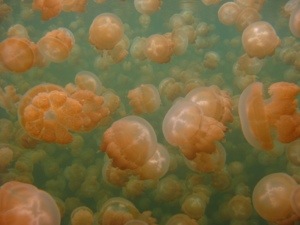
This has been a game of careful what you wish for…no rain and LOTS OF SUN…it was a hot day, but also a fascinating day! We started out with a boat ride to Jellyfish Lake, one of the coolest places I’ve ever been. We hiked up some rocky stairs made for giants, over the top of a hill, and back down onto a dock where we jumped in for a snorkel.

DIVE IN!
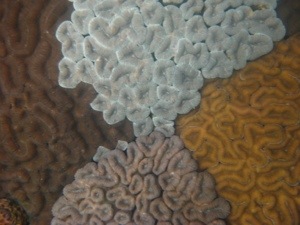
brain coral

Exploring the Rock Islands: Milky Way and Einstein’s Gardens

Margie’s Beach

The tents were spread out along the sweeping sandy beach that looked out onto calm, turquoise water protected by a reef to the left which was home to WWII Japanese Zero airplane. A young 19 year old pilot safely landed it on the reef as opposed to crashing the plane Kamikaze style, as they were taught.

EXPLORE!
kingfisher bay

Exploring the Rock Islands: Risong Bay Area

It was a warm night of camping at Lee Marvin Beach, and I think most of us were awake before the sun even rose. Ludy called us to breakfast with a conch shell. It sounded like a fog horn. We feasted on sunny side up eggs, bacon, sausage, bagels, and fruit. Today we planned exploring Palau’s Rock Islands in the Risong Bay Area.

EXPLORE!
Ellen kayaking in Nikko Bay

Exploring the Rock Islands: Nikko Bay

On our third day at Palau Pacific Resort, we enjoyed another amazing breakfast buffet. It’s amazing how excited we got over seeing what would be offered…vegetable of the day, a soup, beans, hashbrowns, pancakes, a variety of breads, eggs, noodles to order…the list goes on. Today’s breakfast was of Korean influence!

PADDLE AWAY!

Boating and Snorkeling Around Ulong Island, Palau

On our second day at the Palau Pacific Resort, we started out with another amazing breakfast buffet. The Asian food had a Korean flare….noodles in sauce and dim sai. Of course, I also had to try the Sausab Fruit. It was the consistency of a banana and a pine-apple with a sour taste.

Cruise Through Tarzan Bay

After our breakfast, we took a cruise through Tarzan Bay to Ulong Island. Our guide, Jayden,with Bax the boat captain and Hamilton pointed many interesting sites. Our first stop was at a WWII canon. Who knew the Rock Islands of Palau were a strategic battling ground in the war? I didn’t…but then again I’m not much of a history buff. I’ve included some brief history below.

Palau and WWI

After gaining control of the islands from Germany during WWI, the Japanese were granted a League of Nations Class C mandate to administer the territories. As such, Koror became a mini Tokyo to the Japan as they pushed economic development and built schools and hospitals. Soon the Japanese immigrated to the islands, outnumbering the locals two to one in the 1920’s. In the 1930’s, Japan began fortifying the islands with bunkers, intricate cave systems, and airstrips, viewing them as unsinkable aircraft carriers.

WWII Canon in Palau

Palau and WWII

During the Pacific War and WWII, Palau (in particular the island of Peleliu) became a battle ground between the USA and Japan. As part of General MacArthur’s strategy to take over the Philippines, invade Okinawa, and ultimately the mainland of Japan, it was determined the USA needed to control Peleliu and its airstrip. It was thought it would only take four days to takeover Peleliu; however, due to a change in defense tactics by the Japanese the battle took two months in the fall of 1944 for the USA to win. The battle of Peleliu was the deadliest in the Pacific…the USA suffered 9,800 casualties while the Japanese lost 13,000. The battle was also highly controversial after the island wasn’t ultimately needed to support later attacks on Japan.

Sea Snake Rookery

Not far from the canon, was a banded sea snake rookery. Technically, it is not a sea snake, and is sometimes called a krait, because it leaves the water to nest. We only found one small male resting on the rocks, all the rest were out fishing as a new moon was approaching. Normally, the nesting area is so populated with snakes, that we couldn’t have disembarked the boat as we did. I would have been bummed not to see one, so I’m glad we did. But as Jayden pointed out, we will get a chance to see them in the water! The snakes are extremely poisonous (deadly), and there is no anti-venom, so hopefully I won’t swim into one, though they seem shy.

sea snake rookery

Snorkeling at Fish Bowl Reef Near Ulong Island

From the rookery we glided across the aqua waters past some WWII bunkers to our first snorkeling spot at Fish Bowl Reef. Here we saw countless butterfly fish, moorish idol, clown fish, wrasse and a swimming sea snake! The krait was on the surface, and then it dove down to the sandy bottom…so cool.

Lunch on Ulong Island

After our snorkel, we weaved throughout the shallow bays of the Rock Islands looking for salt water crocs, admiring the White Tail Tropic Bird, Collared Kingfisher, and sea turtles before swinging by Ulong Arch and finally landing on Activity Beach on Ulong Island for lunch. We enjoyed a traditional Palaun lunch basket loaded with food…crab, chicken, spinach patties, sliced taro, sliced sweet potato, almond nuts, coconut candies and more while we learned about the first settlers of Palau.

Settlers of Palau

It is thought Palau was settled by the Austronesian (western Malayo-Polynesian) speaking groups from the Philippines. The winds and currents near the equator in the Pacific pushed their boats to the Rock Islands of Palau by chance. They then migrated to the larger of island of Babeldaob. After our brief history lesson, we took a short walk to the lower part of a terraced ancient village and looked at old pottery and shell remnants used for water and spears respectively.

Megapode

We were surprised by a few unexpected rats….gross…but we also saw the endemic Megapode, a chicken-like bird. The megapode builds its nest, a large mound of sand and compost on the ground, and buries its eggs in the mound. It regulates the heat of the mound by removing or adding debris in order to incubate its eggs, as it does not use its own body heat like other birds. They are shy creatures, and scatter as soon as anyone comes nearby (thus no picture).

First Contact Between the English and the Natives

Before leaving Ulong Island, another short walk along the beach took us past the wing of a Japanese Jake plane to a monument built for Wilson, an English sailor who shipwrecked on Ulong in 1783. He was the first to make friendly contact with the natives, and eventually took the King of Palau’s son, Prince Lee Boo, to England. He is credited with naming the archipelago, the Pelew Islands.

Natural Arch of Palau

After lunch we trolled past some rock pictographs and the famous Natural Arch of Palau. We also visited a small Rock Island where a piece of the limestone had recently calved. Yes, it happens to rock too, not just ice. Limestone is porous and tree roots grow through the rock in search for water. Eventually the rock breaks off into the water.

Soft Coral Arch

Our final stop before returning back to the resort for the day was Soft Coral Arch where we swam back and forth with the current beneath the arch to admire all the colorful soft corals.

We ended the day with a nice dinner, including native dancing entertainment and cheese ice cream, at the resort with our group. We are looking forward to our Exploring the Rock Islands: Nikko Bay tomorrow! ETB

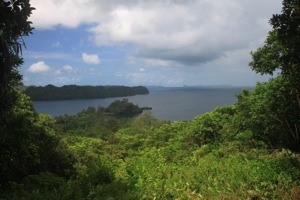
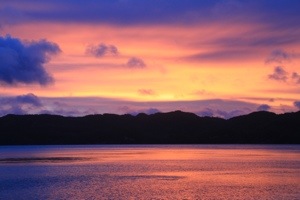
View from hike at Palau Pacific Resort

A Relaxing Day at Palau Pacific Resort

After a long day of travel with a layover in Oahu and a transfer through Guam, we finally made it to Palau at 9:30pm. We looked forward to a relaxing day at the Palau Pacific Resort in the morning. The resort is lovely, with nicely groomed grounds, a pool, and beautiful beach. It operates, at least partly, on solar as indicated by a posted sign registering the current output.

RELAX!