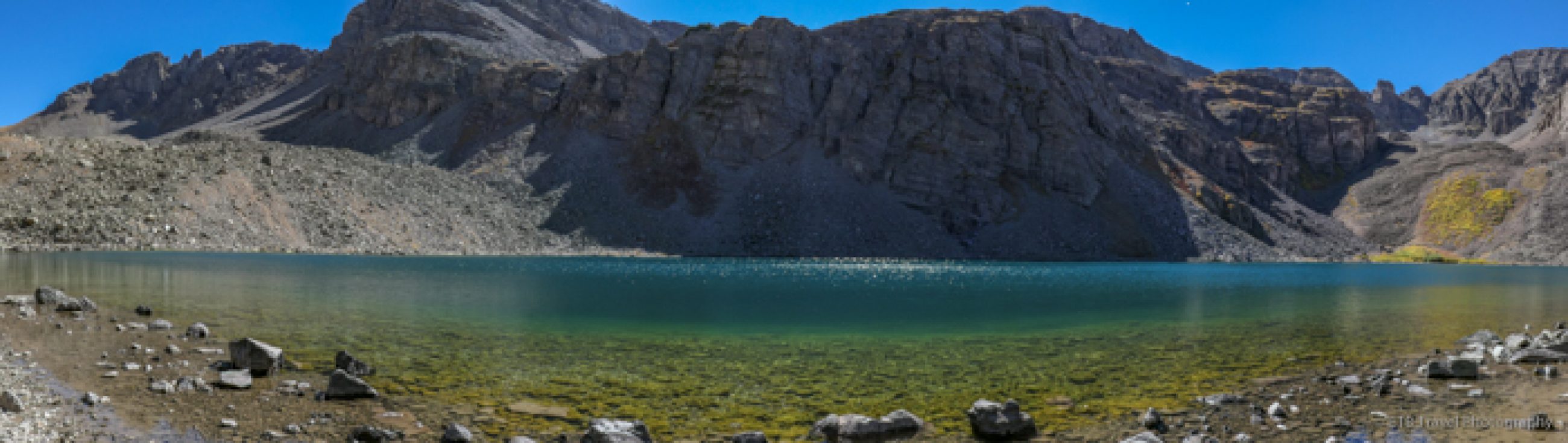
I recently returned from SCUBA diving in Indonesia on the Mermaid II liveaboard. The 7-day itinerary was Bali-Komodo-Bali, and we dove six of those days, with the rest being transit.
The Mermaid II spends most of its time in Bali, Komodo, and Raja Ampat with a few weeks in Lembeh, Alor, and the Banda Sea. The SCUBA diving in these areas is superb! The marine life and biodiversity are like none other. Mantas swoop overhead while rare nudibranchs, frogfish, pipefish, and pygmy seahorses hide in the colorful corals.

Table of Contents
SCUBA Diving in Indonesia
I have been diving in Dominica, Saba, Cozumel and many other Caribbean destinations as well as the Philippines, the Solomons, the Maldives, Australia, and the Red Sea, and Komodo ranks near the top! In fact, Komodo is located in the Coral Triangle, which is the most biodiverse marine region on the planet. I was so intrigued by all the different critters, that I did every dive…including those at night.
My dive buddy knows that never happens. I am typically content with two dives a day, so to do four a day is saying something. While the diverse and plentiful marine life was certainly a draw, the dive schedule was also quite nice. We didn’t have to get up at the crack of dawn or go diving late in the evening.
The daily activities typically followed the below schedule:
- 6:30 small breakfast
- 7:30 dive
- 9:00 big breakfast
- 11:00 dive
- 12:30 lunch
- 15:00 dive
- 16:30 snack
- 18:30 dive
- 20:00 dinner
Occasionally we substituted a hike, a village visit, or a chance to see Komodo’s Komodo Dragons, but for the most part, we spent a lot of time underwater. In fact, we maximized most of our Nitrox dives and stayed down a full hour.
Dive Boat Liveaboard in Indonesia
Before I get to our dives in Indonesia, the Mermaid II deserves a short description. For the most part, this 33-meter, twin engine steel motor yacht was quite comfortable. The boat features eight deluxe cabins and two budget cabins which in total accommodate 18 guests.
There is also a dining room, salon, covered deck, sun deck, and dive deck. All these spaces are compact but serve their purpose adequately. Some nice amenities on this dive boat in Indonesia include fresh towels after each dive; complimentary snacks, tea, coffee, and non-alcoholic drinks; and excellent meals including hot chocolate after each night dive.

Diving from the Mermaid II
I’d be remiss if I didn’t mention the spectacular staff. From start to finish, the dive crew was excellent. We began with a dive briefing about 30 minutes before our dive. We were divided into two sections with smaller sub-groups. Section A geared up first one day and section B geared up first the next day.
The smaller sub-groups of four, each with a divemaster, were the ones we dove with the entire trip. Julie and I dove with Doug and Luann. Given we had a large group of new divers onboard who all knew each other, the crew adjusted the size of the groups as needed to accommodate them.
After the dive briefing, one section descended to the dive deck while the others waited in the salon. Upon loading in the tenders, the next section geared up. Our tender drivers literally put our fins on for us! We just held on as we zipped off to the dive site where we did a back roll entry off the zodiac. Only one site required a negative descent.
Upon completing our hour dive, the divemaster sent up the SMB, marking our location for pick up. Soon, the tender was back. The drivers collected our fins, weights, and BCD’s before we climbed on board via a small ladder.
Back at the Mermaid II, the dive crew literally undressed us! They peeled off our wet suits, rinsed our gear (including our wet suites), and hung it to dry or added it to our individual boxes after each dive. All we had to do was rinse our cameras and masks in one of the five tanks, grab a quick shower on the dive deck, and dry off with our fresh, numbered towel before we walked on the indoor carpet. The service was impeccable! Now on to the dive sites in the Flores Sea.

Dive Sites in Indonesia
The dive sites in Indonesia range from wall dives loaded in soft corals to mud dives filled with small critters. They also include iconic sites like Manta Alley where chains of mantas glide between the coral formations near Komodo Island and Shotgun where the current shoots divers tumbling between two islands.
Depending on the time of year, the water clarity and temperature change between the north and south part of Komodo National Park. This affects manta sightings as they prefer cold water and plankton.
We visited at the end of October which is not the peak time to see mantas in Indonesia, but it is still possible. We were fortunate to see five or so. If a manta “chain” sighting is your primary focus, however, book your dive trip to Komodo between December and February. If however, you want a lot of dive sites to yourself, October is an excellent time to visit.

Our Dive Itinerary
Day 1 – Moyo Island Dive Sites
Given the distance from Bali to Komodo is a bit far, we made a stop in between at Moyo Island (also spelled Mojo) for our introductory and check out dives. Moyo is off the north coast of Sumbawa in the West Nusa Tenggara province of Indonesia.
The island, one of 17,508 islands in Indonesia, is undiscovered by tourists. Though there are a couple of lodgings, including Aman Resort which famously hosted Princess Diana years ago and carries a price tag of $2,000/night.
Moyo Island, including its coastline, is a conservation area. As a result, its coral reefs and marine life are protected from commercial fishing and pollution. The dive sites on Moyo Island that we visited were:
- Dive 1 – Angel Reef
- Dive 2 – Sumbawa Wall
With a light current and mediocre visibility, these two dives were not my favorite. But of course, there is always something cool in the vast seas and oceans. And the giant school of fish that buzzed by us at the end of our first dive was a treat! I also enjoyed seeing the superb soft corals, cleaner shrimp, nudibranch, clownfish, fish eggs, and active sea cucumbers.

Satonda Island
From Moyo Island, we motored to nearby Satonda Island. Satonda Island, along with the Island of Sangeang, are the eruption centers associated with Mount Tambora. This 1815 volcanic eruption is the largest and most devastating eruption observed in recorded history.
We took a hike to Santonda’s soda lake which fills two large craters and takes up 2/3rds of the small island. The high alkalinity lake has three chemoclines and is very important to scientific research in the formation of organisms from 66 million years ago.
Who knew our short sunset hike would take us to a place so influential in science that seems unremarkable on the surface! I don’t think I even took a picture of it. But the sunset on the beach was pretty! Any science geeks, however, would enjoy reading this Wikipedia link about the soda lake!

- Dive 3 – Satonda Sandy
After our short hike, we made our third dive of the day. The night dive followed a sandy, volcanic slope off Satonda’s shore. It featured all sorts of critters, though my flashlight beam was so dim, that I didn’t capture one photo.
Komodo Island
From Satonda, we spent a rough night motoring to Komodo. A rogue wave rocked the boat so hard, we woke in the middle of night as a few of our belongings flew of the shelf. Fortunately, the seaworthy Mermaid II brought us safely to our next day of dives in Komodo. In fact, we would spend the next three days bouncing from bay to bay in the protected coves between Komodo and Rinca Islands.
Komodo Island is part of the Lesser Sunda chain of islands and is part of the East Nusa Tenggara province. As noted previously, Komodo Island supports rich marine life, though it is likely best known for the Komodo Dragon which is protected in the Komodo National Park. It is also one of the New 7 Wonders of Nature.
Day 2 – Dive Sites in Komodo
While we designated the morning of day 4 in our itinerary to see Komodo’s Komodo Dragons, our second day on the liveaboard in Komodo focused on diving in Komodo. We dove the following sites:
- Dive 4 – Gili Bantu Bay
- Dive 5 – Batu Moncho
- Dive 6 – Castle Rock
- Dive 7 – Wainilu
The marine life was plentiful. Magnificent soft and hard corals, stingrays, sea stars, anemones protected by clownfish, moray eels, sponges, nudibranch, lionfish, angelfish, butterflyfish, and all sorts of other fish that swam away too fast for my disappointed, trigger finger were just a few of the highlights.
Underwater photography can be so humbling. So much so, that I spared myself the agony during our night dive at Wainilu and left my camera behind!
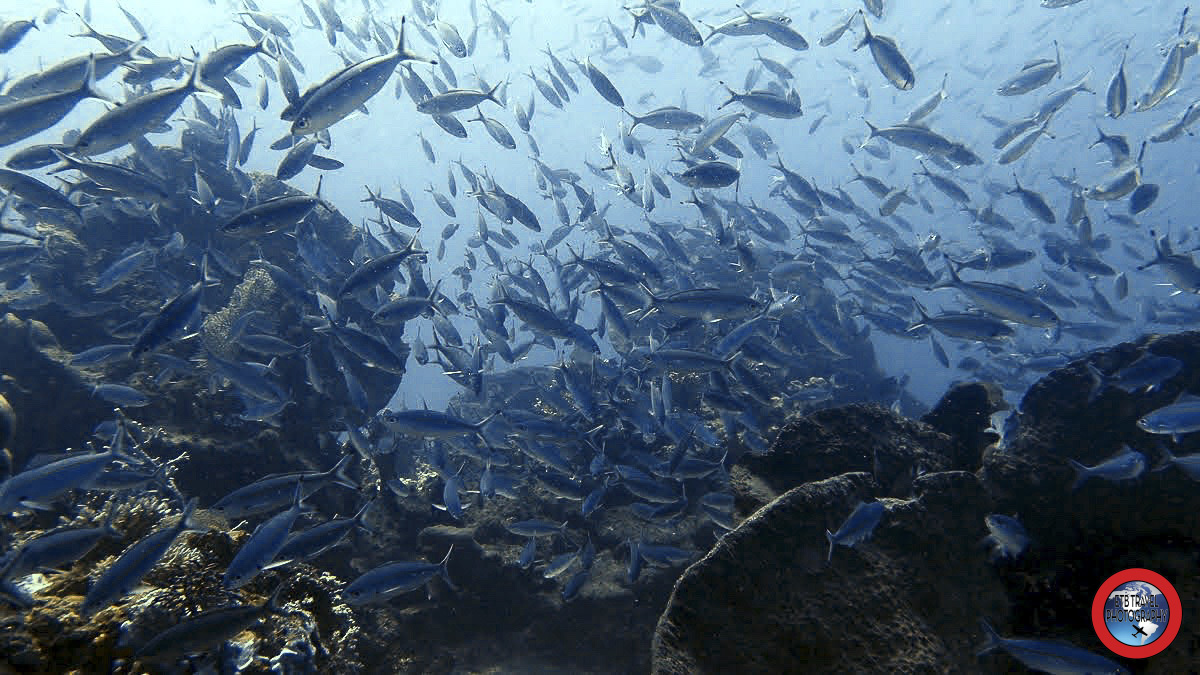
With the diving conditions of the day, Batu Moncho was my favorite. Schools of colorful fish hovering around the corals, gave us a feeling like we were in an aquarium!

Day 3 – Rinca Island Dive Sites
From Komodo we turned southeast toward Rinca Island which is also part of Komodo National Park and part of East Nusa Tenggara, Indonesia. For this day of diving in Indonesia, we visited the following sites:
- Dive 8 – Manta Alley
- Dive 9 – Cannibal Rock
- Dive 10 – Yellow Wall
- Dive 11 – Torpedo Bay
While the iconic Manta Alley dive site in Komodo National Park didn’t have tons of mantas, a few glided by in the murky water. Unfortunately, my camera case fogged, so I have little to show for our brief sighting of these majestic creatures.
On the flip side, I fared a little better at Cannibal Rock which was absolutely spectacular! I have never seen so many nudibranchs in my life. And they were HUGE! And I have never heard of a sea apple. These colorful and somewhat round sea cucumbers dotted the reef.
I’ve never seen such beautiful sea urchins that looked like a round rainbow. The lavender frogfish was so big that I thought it was piece of coral. And the cuttlefish was enormous! I really can’t describe the size except that they were both the biggest I’ve ever seen and the pictures don’t do them justice. With the unusual shapes of coral and all the bright creatures, the reef was like a scene from Alice in Wonderland.


The night time dive in Torpedo Bay was unreal. Of course, there were tons of shrimps and crabs, but some of these odd shaped, hairy critters were so unique they looked like they belonged to another planet!
I particularly liked seeing the bobtail squid, one of many first-time sightings for me for the night. The gold and white snake eel buried in the sand was beautiful. There were sea slugs, nudibranch, and flatworms galore. I particularly liked seeing the flatworms swimming and the nudis mating! The live cowrie was cool to see too. Usually, you see the shell in a souvenir shop.


While most people would have picked the manta dive as their favorite, I was just mesmerized by all the variety, colors, and sizes of the marine life at Cannibal Rock.
Day 4 – Another Day in Komodo
Rinca Island was the farthest east we traveled in Indonesia. The following day we returned to Komodo to see the world’s largest monitor lizard and to learn all about their dangerous tendencies. We then made two day dives and had a choice of a hike or dive for the evening.
Itinerary
- Komodo Dragons
- Dive 12 – Mawan
- Dive 13 – Shotgun
- Dive 14 – Gili Lawa Darat Bay
Sunset Hike on Gili Lawa Darat
I guess I lied because I did miss Dive 14 and opted for the hike on Gili Lawa Darat. But I didn’t just sit out a dive like I sometimes do occasionally. The name Gili Lawa Darat means the island close to land. It is located in the northern part of Komodo National Park and best known for its sunset and sunrise hikes. Though the friendly deer that greet you on the beach were fun to see too, except they were malnourished and thirsty. We poured some water on the dock and they lapped it up.
The 0.9 mile loop hike gains almost 500 feet in less than ½ a mile. While the incline is moderate, the distance to the peak is short, so even beginners can do it. Not counting the time at the top, it takes about 45 minutes to complete the trail. The panoramic views overlooking Komodo Bay are worth the effort. Many say they rival those of Padar Island without the crowds. I loved the contrast of the golden hills with the turquoise waters and pink sky.

Komodo Dragons
I also LOVED seeing the Komodo dragons on Komodo Island for our first morning activity. I had no idea they could be so big and dangerous. For more details, visit my post Komodo Island’s Komodo Dragons.

Mantas and Shotgun
For our two day dives, we were lucky to spot some shark, a few more inquisitive mantas that glided right over the top of us, clownfish, clams, four pygmy seahorses on one seafan, lots of feather stars, lovely soft and hard corals, a turtle, angelfish, Moorish idols, butterflyfish and more. We also went flying through the current at Shotgun, for which it is famous!
Day 5 – Sangeang Island
Continuing back to the West toward Bali, for our fifth day we dove around Sangeang Island. The island is home to one of the most active volcanoes in the Lesser Sundra Islands. Remarkably, despite the eruptions, there is a small community on Sangeang called Bontoh.
Bontoh Village
We visited the small settlement before our night dive which was the best of the week! We disembarked on the black sand beach littered with outrigger fishing boats.
While they use the outrigger fishing boats to catch dinner, they actually make boats for a living. Goats clopped on top of the pile of wood that is shipped to the island to make the boats while water buffalo rested on the far side of the beach.
As the men worked and the children played, the ladies hung up their colorful sarongs for us to buy. Then we took a short tour through their village of wood and corrugated iron shacks, each with a thatched roof, to see their way of life.


Sangeang Dive Sites
- Dive 15 – Hot Rocks
- Dive 16 – Lighthouse Reef
- Dive 17 – Tikno
- Dive 18 – Bontoh
Our dives today were some of the best and some of the worst! At the Hot Rocks dive site, we saw FOUR pygmy seahorses on one sea fan! Up until this trip, I had only seen four pygmy seahorses in my life. What a treat!
And the nudibranchs on Hot Rocks and Lighthouse Reef were out of control. So many different species, colorful, big and rather active inching across the sand and coral!


Tikno, however, was miserable. If the moon had wind, I’d say it was like being a tumbleweed on the surface of the moon. We tumbled in the current across black sand for what felt like hours, though it was more like 30 minutes. There was little chance of stopping for a photo without digging our pointers in the sand and kicking. At least we saw a ghost pipefish before finally reaching a calm spot where we cut the dive short and surfaced!!
Fortunately, our final night dive was absolutely spectacular!!!! I really dislike night dives, and I didn’t want this one to be over. We saw so many critters!! Two hairy frogfish, worms eating a fish, nudibranchs mating, a seamoth, stargazers, and red dwarf lionfish were just a few of the creatures hiding out on the sandy slope. Each time we aimed our flashlight in a different spot there was something to see…what a rewarding scavenger hunt!


Day 6 – Moyo Island Dive Sites
Our final day of dives in Indonesia before the crossing to Bali to disembark was again at Moyo Island. I wasn’t too enthusiastic to dive here again as I didn’t like the dives that much the first time. Oh my gosh, I need to remember nature is constantly changing. It is like going on Safari in Africa…you always see something new.
There were fish everywhere and the visibility was outstanding. Coupled with a sunny weather, this reef was a photographer’s paradise.
- Dive 19 – Angel Ridge
- Dive 20 – Little Angel
Jawfish, starfish, mantis shrimp, clownfish, scorpionfish, a turtle, and eels were just a few memorable species. Unfortunately, I had trouble with my camera set up the entire trip for a variety of reasons (including user error), so I did not do Komodo’s beautiful marine life justice.


That said, I will take home a lot of firsts and awesome memories of amazing diving in Indonesia. In addition, I will never forget the kind ways of the Indonesian people nor some of the most interesting passengers I’ve ever met on a dive boat! ETB
Like It? Pin It!


Looks amazing! We want to dive in Raja Ampat soon, would you recommend this company? Maggie
Yes. They are great! I’d like to do Raja Ampat too. Lmk when you are going!!
I will
Your pictures are AMAZING! I’m particularly intrigued by the night dive. It’s nice to see everything in one place for easy viewing for when I plan a trip there. Thanks for sharing!
Ohh wow these pictures are so beautiful! Did you use a GoPro to take the underwater pictures, they are so vivid! I actually start swimming lessons on Tuesday so that I can hopefully become a better swimmer so I can snorkel and scuba on my future trips 🙂
Wow how incredible, it’s absolutely stunning!
Holy cow! Sorry to miss this one! Looked absolutely incredible!
Amazing experience! Because I’m pretty terrified of the water, I don’t think scuba diving will ever be on my list. So it’s great to follow along on your experience and live vicariously 🙂
I never thought I’d be a diver. I’m not the greatest swimmer and the thought of being underwater where something could malfunction made me a nervous nelly. Then i couldn’t stand being at the surface when all the fish were so far down. I just about hyper ventilated the first time I had to put all the gear on. And I told myself. You are in the pool. You can stand up if you don’t like it! Then I was hooked, though I’m always a little antsy my first dive back. I won’t get in any water I can’t see in, so I get where yo are coming from
The diving in Indonesia looks amazing!! And lucky you that the dive crew rinsed all your gear every time you returned to the boat. Beautiful captures. I’m still not brave enough to do a night dive! I’m not a fan of the dark!
I know. We were spoiled!
This sounds absolutely incredible. Definitely something to put on my bucket list
It was pretty great!