
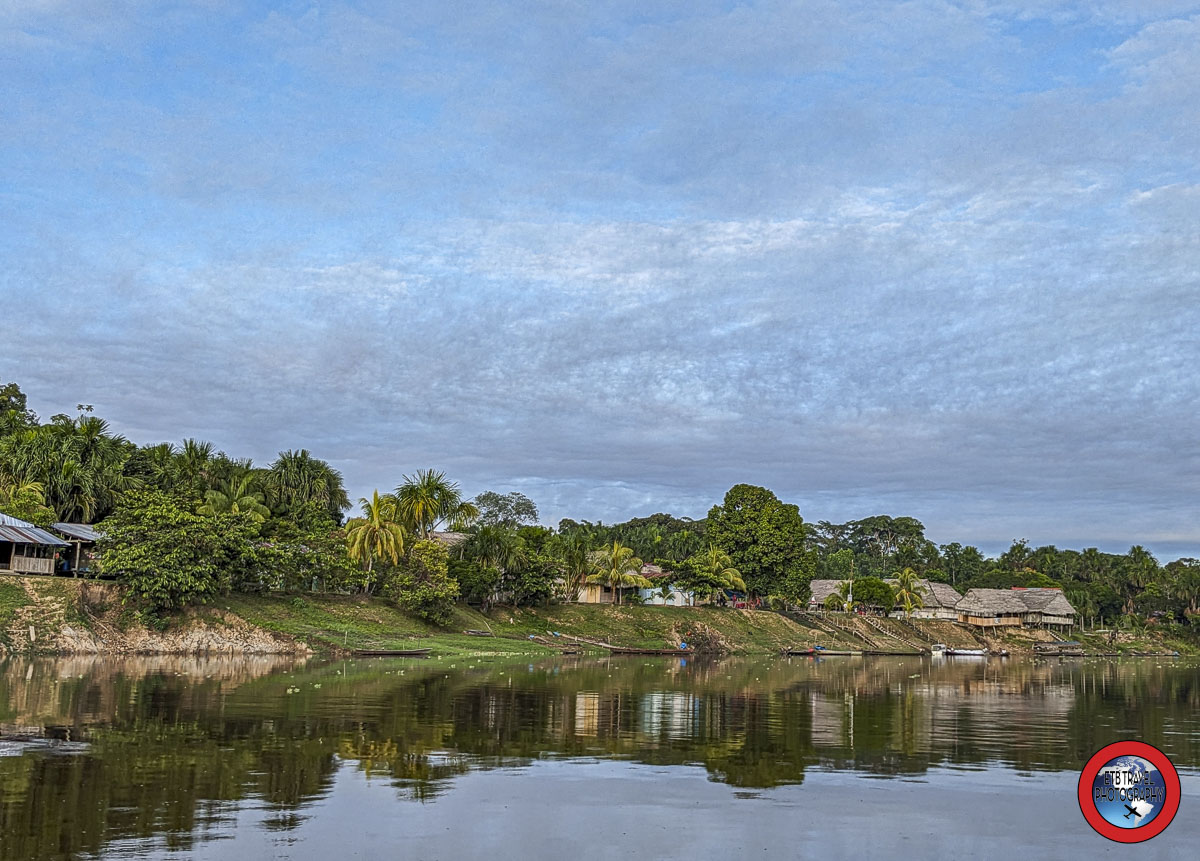
For our fourth day on our river cruise by G Adventures in the Peruvian Amazon, we began with an early morning skiff ride down the Nahuapa River, a tributary of the Marañon River. The plan was to enjoy a box breakfast on the skiff while watching the dolphins. Unfortunately, they didn’t show, but we still got to enjoy the surrounding nature along the way. It’s about the journey, not the destination, right?

Pin It For Later
Table of Contents
The tributary in Pacaya-Samiria National Reserve looked like velvety chocolate! We felt like we were in Willy Wonka’s chocolate factory as the dark and milk chocolate waters met. It was really neat to see the distinct difference between the rivers. The glass-like surface created magnificent reflections of the shoreline trees. And the small floating islands of vegetation were super cool!
As with our previous morning skiff rides, we mostly spotted birds perched high in the ficus and fig trees. A few were close enough to photograph including the tiger heron, the black collared hawk, the white throated toucan, the flycatcher, and five long-nosed bats. The kingfishers darted around so fast it was almost impossible to capture them. At least the blooming carnivorous plants stayed put!


Buenos Aires on the Marañon River
After our boxed breakfast which included sandwiches and fruit, we visited the Buenos Aires community, not to be confused with Buenos Aires, Argentina. The community, with two bathrooms, offered us a pit stop. Seeing the long line, Uciel encouraged some of us to go behind one of their huts.
Surprisingly, the men waited in line, while my friend and I (hikers at heart) copped a squat in the bush. Of course we entered cautiously, checking for snakes and any other thorny or scary looking plant! With our pit stop came routine shopping. This community made some lovely jewelry with palm nuts and other resources from the jungle.
We also got the opportunity to take canoe rides. We loaded in their hand made boats by pairs. My friend took the bow and thus the paddle. I sat in the middle. And the young girl, no older than fourteen, took the stern and the other paddle.
Unfortunately for her, my friend had twice her strength and after going in a circle, we ended up back at the shore! Her dad came to her rescue. Only, by this time, we were far behind the other canoes and in the middle of the tributary rather than close to the side. It was reminiscent of our mokoro ride in Botswana when we lagged the pack!

My friend, who knew French not Spanish, was miffed and wanted me to direct our captain. I was just trying to enjoy the tranquility, but peace was eluding me, so I practiced my Spanish and asked the captain to get closer to the group and move to the side.
In our conversation, I also learned our captain had two kids and moved to Buenos Aires for work. At first, I was thoroughly confused because I didn’t realize the name of the Amazonian Community was Buenos Aires!
Having seen the large, yet simple community, I couldn’t help but wonder what job lured him there. It turns out, he climbs trees to collect fruit! It is hard but pays well.
He also told me the type of tree they use to make their boats, but I couldn’t understand the name. The wood is strong and has good waterproof qualities. Additionally, he said, he doesn’t usually row it, but uses a motor. That explains it!
Anyway, our planned 30-minute canoe ride became much longer as the leader of the pack never turned around. The skiffs had to come get us and we did a canoe to skiff transfer, much like our kayak to dinghy transfers when kayaking in Antarctica.
Veinte de Enero
From Buenos Aires, we visited a neighboring community called Veinte de Enero which is named after its founding day, January 20th. This tribe did a lot of gardening and together with G Adventures, they plant trees to combat deforestation mostly caused from the demand for cocaine which comes from the coco tree.
During our visit to Veinte de Enero, we planted seedlings. I asked where the trees came from, and they dug them up from another part of the forest! I thought we’d be planting new trees. Maybe adding them to the orchard of fruit trees in the community will help them tend to the palms better and harvest the fruit.
Of the communities we have visited thus far, Veinte de Enero seemed to be in the best shape. All the towns have a central square surrounded by open air, wood houses. The houses feature thatched roofs and sit on short stilts. The central square of either dirt or grass dons wood goal posts and operates as soccer field. It would be blasphemy for any South American community not to have a pitch!


Afternoon Hike in Amazonian Natural Park on the Marañon River
After our morning adventures which included a brief rain shower, we returned to the Amatista for lunch and relaxation on the Marañon River. At 4 pm we prepared for an afternoon hike. According to Uciel, the hike would be five miles along a trail and atop seven suspension bridges, once used by scientists to study the jungle canopy.
We loaded onto the skiffs to get to shore. I wondered what we were getting ourselves into as the paramedic, carrying a stretcher, joined us! Given the snail’s pace we took during our first jungle walk, there was no way we’d be finishing five miles before dark at 6 pm. Off we went!
I was surprised to find the ruins of an old house and pool in the Amazonian Natural Park. It turns out, we were hiking at the defunct headquarters of the company that first started tourism in the Amazon.
The trail, which was mostly dry, was well maintained. Round cuts of tree trunks filled in the path at wet spots. The vegetation was much of the same, giant thorns and buttress roots protruding from the trees.
I loved seeing the vines climbing the trunks as well as one of the few remaining rubber trees. We learned how they tap the tree to extract the white liquid latex which hardens in approximately 24 hours.


Before we reached the suspension bridges, the highlight of the hike was seeing thousands of leaf cutter ants marching across the trail with pieces of tree leaves. The ants can take all the leaves of a tree in just 24 hours! I’ve seen this before, but never to this magnitude.
By the time we reached the suspension bridges, the light was fading. We formed groups of three or four to limit the amount of people on the bridges at once. We bounced along, high in the canopy, so thick that the rain hardly penetrated it. Or perhaps we were so sweaty from the humidity that we didn’t notice.
I was grateful to cross the bridges with my friends first, because the groups at the end had to do it in the dark! Donning headlamps, we continued through the jungle in darkness for the next hour in search of night critters. We found a tarantula, other spiders, a frog, and a bush cricket.


Of course, we couldn’t leave the jungle without at least turning off our lights for a minute to listen to all the sounds, as we did on our evening skiff ride yesterday. It was like being in a pitch-black cave listening to a cacophony of noises. In all, we spent three hours in the jungle, though the five-mile hike was more like 2.5 miles.
White Tomato Juice
Upon our return, Edgar had whipped up some Bloody Mary’s with the popular white tomato juice they serve every morning. I think the citrus flavor didn’t quite work for the Bloody Mary, but it was a good try. When in Peru, it’s probably best to stick with the Pisco Sours, though the tomato juice kills the salmonella typh bacteria.

I wish I knew that before I visited the Amazon. I would have drank it every morning. Then perhaps I would have staved off wicked food poisoning in Cusco the day after leaving Iquitos. But I digress. It was another nice day on the Marañon River. ETB
Other Articles About the Amazon You May Like
- Peruvian Amazon: Part I
- Peruvian Amazon: Part II
- Peruvian Amazon: Nauta and the Samiria Pacaya National Reserve


Another interesting post from the Amazon and the lovely area of Buenos Aires (Peru not Argentina). 🙂
Thanks!