For our second day in the Peruvian Amazon with G Adventures, we began with a pre-breakfast skiff ride. Donning our life vests, we loaded onto the skiffs around 6:30 am as the sun rose overhead. We cruised the bank in search of wildlife and birdlife near Huasi Village where we “anchored” for the night. Anchored is in quotes because they don’t use an anchor or a mooring. Instead, the just beach the boat on the shore!

Table of Contents
Red capped cardinals, black collared hawks, fly catchers, macaws, and martins were a few of the early risers. We also spotted our first sloth on the trip. Despite having visited Costa Rica, Panama, Nicaragua, Columbia, Brazil, and Honduras, all countries home to sloths, I had never seen one. Consequently, I was elated to finally spot one in the wild!


Sloths
There are two-toed sloths and three-toed sloths. We saw the brown-throated sloth, which is the most common three-toed sloth in Central and South America. It sleeps 15-18 hours a day and spends most of its time in treetops of the high canopy forest where it consumes young leaves.
The brown-throated sloth only descends the tree about once every eight days to defecate, so chances are you may spot them in the same location for a few days. They look like a blob from afar. At least, that is how our guide Uciel pointed him out.
“You see that blob in the tree? That’s a sloth!”

After about one hour on the skiff, we returned to the Amatista for a buffet breakfast which typically included fruit, eggs, pancakes, breads, cheese, potatoes, vegetables, meats, and fresh squeezed juices. It’s hard not to overeat!!
Grey and Pink Dolphins in the Peruvian Amazon
Our next outing began around 9:45 am. Again, we loaded up on the two skiffs, and this time made our way into the Yanayacu River. At the confluence of the Amazon and Yanayacu, we saw several grey and pink dolphins! One of my biggest reasons to visit the Amazon was to see the freshwater pink river dolphins, so this was a thrilling experience.
With our heads on a swivel, we watched as the dolphins surfaced and dove for their morning meal. At the start of the dry season in June, you find the dolphins at the confluences because the fish swim upriver to spawn and quickly return to the Amazon as to not get trapped before the water recedes. From the wet to the dry season, the water level drops as much as 36 feet!
While it was fun to see the dolphins, it was extremely hard to snap a photo. I had to borrow a photo of grey dolphins from my friend. Though attracted to the skiff motors which briefly disorient their prey, the river dolphins don’t surf at the bow like they do in the ocean.
Interestingly, there are many differences between the grey and the pink dolphin. The grey dolphins are smaller, faster, and swim all the way to the ocean. The pink dolphins are larger, slower and surface less often. Since they do not swim to the ocean, their bodies have adapted to hunting in the river. They have a longer beak, flatter dorsal fin, and a neck with unfused vertebrae. As a result, they can turn their heads 90 degrees and are more flexible to maneuver around tree roots and other obstacles in search of prey.
Pink dolphins are not born pink, but instead grey. Gender and age factor into their color, with older males being the pinkest. Also, due to their capillaries being close to the outside of their body, they turn pinker with activity.
Though an endangered species and extinct in most parts of the world, the pink river dolphin is considered a mythical creature by the tribes of the Peruvian Amazon and unlucky to harm. Consequently, they are relatively easy for visitors to see, and luckily we had another opportunity later in the trip for more photos.

Egret Alley in the Peruvian Amazon
After many oohs and aahs from our fellow passengers and an “Oh my gosh,” from Uciel in his Spanish accent that made us chuckle, we motored into the Yanayacu River which we later deemed “Egret Alley.”
I am not much of a birder, but I was astonished by the number of egrets that make this area of the Peruvian Amazon its rookery during the dry season. They migrate from the Everglades in Florida each year.
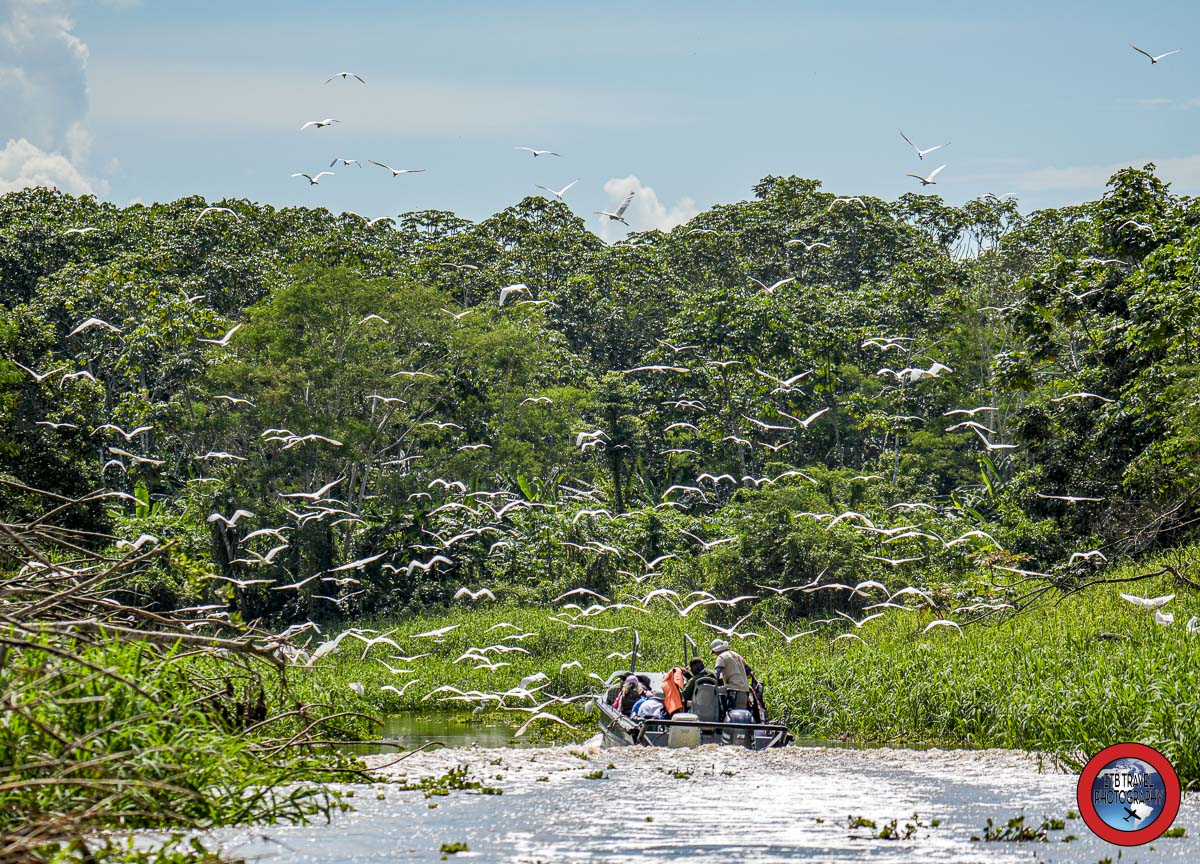
Thousands of egrets perched in the trees, rested in the swampy waters, and took flight as we motored through the floating vegetation, which was once part of “tierra firma” or solid ground. The floating islands come from the shores that erode and calve off into the Amazon like icebergs in Antarctica. Can you imagine being a river boat captain in such an environment where the topography is constantly changing?
Anyway, the egrets were a thrill to see as they hovered about the motor craft in front of us! And the tree full of cormorants was quite a sight. It was also fun to watch the villagers go about their daily lives. One family, piled into their boat, were returning from the championship soccer game!


Heat, Humidity, and Photography in the Amazon
After about an hour on the water, we veered to the left bank and disembarked for a hike. It was like there was a random trailhead in the middle of the jungle. I was hopeful the shade of the tree canopy would help alleviate the hot temperature, but not so.
By late morning, we could really feel the heat and humidity when we weren’t creating our own breeze. In fact, both my phone and camera overheated in the direct exposure of the sun.
Also, I might add, it is so humid that your camera lens will fog up, even between where the lens connects to the camera when going from the air conditioning to outside. Pro Tip: Let your camera sit outside your room for at least thirty minutes before shooting!
Pro Tip: Let your camera sit outside your room
for at least thirty minutes before shooting!
Jungle Walk in the Amazon
The shade of the jungle only created a stagnant, hot air tunnel like a sauna. And June is the early winter. I can’t imagine visiting in the summer! Our “hike” or should I say slow walk in the woods which might have covered a mile in one hour turned into a bit of an adventure.
We trounced through mud, with one lady falling in the mud puddle. And group of us got attacked by an agitated hive of haircutter bees that had fallen to the ground.
Haircutter bees attack your head and get caught in your hair, so much so that sometimes you have to cut it, thus the name. They don’t “sting,” but I can attest that they bite like a horsefly. OUCH!
Fortunately, only one got up my shirt sleeve as I followed Uciel’s shouts to “RUN!” The young German/Chinese couple who I mentioned in my previous post about losing their luggage were not so lucky.
The bees attacked her thick flowing locks as she shrieked, ducked, and danced in place while covering her head. Oh goodness, what a beginning of a trip for them. As she said, “We will remember this vacation for a long time!”
Despite the mishaps, it was interesting to explore the jungle. We learned that the Amazon only has ten inches of topsoil, thus the tall canopy trees grow huge buttress roots that help stabilize them. We also saw spiders, funghi, lichen, termite mounds, tree trunks with three-inch spiky thorns, and even two bandits. Just kidding, those were my friends with their buffs pulled up to keep insects from biting them! Though with all the deet we were wearing, the mosquitos proved sparse.


With my shoes covered in mud, it brought back memories of hiking on the Kenai Pennisula in Alaska during the rainy season. I was grateful for the crew who cleaned our shoes! And I was also thankful not to be hiking during the Amazon wet season. That said, there are more skiff rides and less hiking when visiting the Amazon between December and May.
After our hike, we returned to our boat via Egret Alley, a delight once again, before settling in for lunch and an afternoon siesta.
Butterfly Farm in Vista Alegre, a Peruvian Amazon Village
Around 4:30 we ventured out again, this time to visit a village community called Vista Alegre. The community raises Dark Owl butterflies in conjunction with the Peruvian government, who has established a market for them. I’ve never heard of releasing butterflies at a wedding, but apparently it is a thing!
Fortunately, they also release a percentage of the large, striking butterflies into the wild. The Dark Owl butterfly is blue on one side and brown on the other with a eye like an owl to confuse their prey. It takes approximately 90 to 100 days to go from egg collection to hatching, a much longer process than that of the monarch butterfly in Mexico.
In addition to raising butterflies in their community insectarium made of wood posts and netting, each household keeps a beehive. We had enough bees for one day, so after the presentation about the butterfly’s life cycle, we took a moment to look at their handcrafted wares.
Shopping was a constant theme in the Peruvian Amazon, and though a bit tedious for non-shoppers like me, I did my best to support it. Tourism dollars make the community realize that it is important to preserve the natural habitat.
Amazingly, our day of excursions wasn’t finished. After dinner and some music by the crew, we went out for a night skiff ride. Aside from an opossum, the nocturnal animals did not participate in the event. The moon, however, was quite spectacular! In all, it was a great full day on the Peruvian Amazon. We really loved the dolphins and “Egret Alley”! We ended our night 120 miles from Iquitos beached at the confluence of the Amazon, Maranon, and the Ucayali. Until tomorrow…ETB
Pin It For Later
Other Articles About Peru That You May Like


Love the sloth 🙂 Maggie
You got some great pictures of the local wildlife there on the Amazon! What a cool experience that must have been 🙂
Awesome photos and what a unique experience. That sloth almost looks like a stuffed animal with a balaclava on its head haha!
Haha. So true
Wow, I’d love to see the sloths and the egrets in egret alley. Add the dolphin and this sounds like an incredible trip!
Sloths are some of my favorite animals so I think it’s so cool you got up close to them. This seems like an adventurous experience!
Hi Bri. What is your blog? I can’t figure out how to find you on FB Women Travel Bloggers since they changed everything