
Planes, Trains, and Automobiles. That’s what it takes to get to the Amazon. Just kidding! I like that movie title, and the title does imply that it takes some effort to get to the Peruvian Amazon, which it does. But more accurately, it takes planes, buses, and boats!
From Dallas, we flew to Lima via Miami and stayed the night before hopping on a plane to Iquitos, Peru. For those who imagine the Amazon is in the middle of the jungle, you might be surprised to learn that Iquitos, the gateway to the Peruvian Amazon, has a population of 500,000!
Iquitos, the 4th largest city in Peru and the capital of the Loreto Region, boasts an international airport and may only be accessed internationally by plane or boat. As a result, it is one of the most expensive cities in the world because everything has to be flown in! For example, strawberries in Iquitos cost 35 soles or almost 10 USD!
While there is one road between Iquitos and Nauta, another city in the Peruvian Amazon, it does not extend further. I was amazed by the size of Iquitos given its relative inaccessibilty in the jungle!

Table of Contents
Pin It For Later
Riverboat Cruises on the Amazon
We accessed Iquitos and the Amazon by a G Adventure Tour. There are several riverboat tour operators of varying prices, but most take a similar route, so there is no sense in paying an arm and leg, as long as you are on a safe, clean boat.
G Adventures contracts out the Amatista one of three boats operated by Jungle Experiences, and the only wooden boat on the Amazon. Their boats, Amatista, Zafiro, and La Perla are all named for gemstones…amethyst, sapphire, and pearl, respectively.
In addition to river boat cruises, it is also possible to explore the Peruvian Amazon, which makes up 60% of the country, through a lodge. Though staying in a lodge will limit the amount of travel distance along the river.

Why Visit the Peruvian Amazon?
Upon researching our trip to the Amazon, initially I was dead set on visiting the Amazon from Manaus, Brazil as I had met a Brazilian on a plane who showed me the convergence of two rivers with different colored water that didn’t mix. I really wanted to see this phenomenon which can be seen to a smaller extent in Peru.
But after many Google searches, the Peruvian Amazon options came out on top. The Peruvian Amazon is smaller which affords visitors a better chance to see wildlife, which is still far away compared to the wildlife in Botswana.
In addition to wanting to see the pink dolphins, I wanted to hike and to fish, as piranha fishing in the Pantanal was a blast. These activities begged the question, when is the best time to visit the Amazon?
When is the Best Time to Visit the Peruvian Amazon?
And the answer is, it depends. The rainy season in the Amazon is from December to May, while the dry season is from June to November.
Being in the southern hemisphere, the rainy season is Peru’s summer. This brings blooming flowers, birdlife, rain, high water, and hot temperatures. The high water affords more wildlife skiff rides into tight areas for better wildlife viewing.
The dry season from June to November is Peru’s winter. As a result, the temperatures are cooler (though still hot and humid). Additionally, the lower water levels afford more hiking opportunities and better piranha fishing. It is also easier to see the pink dolphins, though harder to see some other wildlife since the skiffs can’t get into tight areas.
Since we wanted to hike, fish, see the dolphins, see wildlife, visit some local communities, and avoid as much of the repressive heat as possible, we felt June was the best time to visit the Amazon. June caps off the rainy season with the beginning of the dry season.
Nine Day Riverboat Tour of the Peruvian Amazon
After narrowing down the time, cost, and activities, we selected the nine-day riverboat tour of the Amazon operated by G Adventures, a National Geographic Company.
Of the nine days, we spent one day in Lima, two days transferring to and from Iquitos, and six days on the boat. Our first day of our itinerary in the Peruvian Amazon went as follows:
Iquitos
As mentioned above, after a day in Miraflores, a district of Lima, we joined our G Adventure Tour and flew to Iquitos. We left for the Lima Airport around 9 am for a two-hour LATAM flight which departed at 11:55. With only a 45-minute drive to the airport on a Sunday, we had ample time to make our domestic flight.
Upon our arrival in Iquitos, our naturalist guides, Uciel and Hulbert, greeted us at the airport. We loaded on the bus and waited briefly for one German couple, whose flight from Germany was cancelled and their baggage lost! Kudos to them for having a good attitude about it. While they got things sorted out, we headed into the city center.

For those who didn’t exchange money in Lima, The Double Tree Hotel, located on the Plaza de Armas, exchanged our dollars for soles, as the poor Germans purchased clothes at the airport store, the only store that was open! Despite it being a quiet Sunday, tuk tuks zipped around the market area.
The next to Double Tree was a small artisanal market, where my friends began supporting the economy through souvenir shopping, which became a common theme in the Amazonian communities we visited.
The Iron House and Rubber Boom
Also, across the Plaza de Armas is the Iron House or Casa de Fierro. The Iron House was originated by Gustav Eiffel in 1860 and exhibited at the World’s Fair. As a result, the prefabricated iron house is popularly called the Eiffel House.
It was purchased during the rubber boom in 1890 and shipped in six parts to Iquitos. The first part was too big to make it down the Amazon during dry season, and it was eventually sold as scrap metal used in construction in the central market.
The second part was used to construct the Casa de Fierro, which has been used as a mansion, restaurant, and shopping complex over the years. It is a very interesting architectural structure in the Amazon and a stark reminder of the rubber barons who enslaved local tribes. The rubber boom met its demise after the English took seedlings and planted them in their colonies such as Sri Lanka and Malaysia.

Skiff Ride to the Amatista
Eventually, our bus ride took us to the ferry terminal, where our group of 26 loaded on to two skiffs, donned life jackets, and soon arrived at the Amatista. For the next six days we’d be exploring one of the new seven wonders of nature.
To my surprise, we passed by several commercial fishing vessels. I did not understand that the Amazon is navigated by many ships that transport goods. My friend Gary likened it to being on the Mississippi River!
Our guides, who both grew up in the Amazon, informed us that during the rainy season, it might only take 7-8 days for goods to get to Iquitos, but during the dry season, much longer as the water level changes by 36 feet.

The Amatista
The Amatista includes two decks of cabins and is topped with a third deck with outdoor seating, a bar, and a salon. The dining room is on the second deck and all the skiff boarding takes place at the stern on the first deck.
I really enjoyed having a room on the second deck as it was close to the dining hall and only required one flight of stairs to go up top and down below. As it turns out, every day we came back to an animal made of towels on the bed. I particularly liked the sloth.
After settling into our small twin room with a bathroom, we sat down for a late lunch at 3:30 pm. The buffet style meals featured a variety of fresh and cooked vegetables, many starches, at least two choices of protein, a fresh fruit tray, and dessert. The meals started out very tasty, though toward the end of the trip, the options dwindled.


Nature Outing on the Peruvian Amazon
For our first activity on the Amatista, we joined our naturalists on the top deck to look for wildlife as we sailed southwest on the enormous chocolate colored river toward Nauta. Generally speaking, however, the Amazon River and its tributaries flow east from the Andes through nine countries and into the Atlantic Ocean.
During our sail, we passed by a few tribal communities where we saw members washing clothes in the river and farming their land. Our nature sightings were limited, with some iguanas and a hoatzin being the highlights among the giant kapok trees with red hanging fruits.


Hoatzin
Aside from the beauty of the hoatzin, the bird is nicknamed stinkbird because its digestive system can ferment the swamp plants it eats which creates a foul odor. Its chicks also have primitive claws on two of their wing digits.

Kapok Tree
The kapok tree is giant and can grow 13 feet in a year. It rises above the forest canopy to 150 feet. The tree can produce four thousand fruits at a time, each containing 200 seeds. From the fruits falling in the dry season, the seeds easily spread to colonize the forest.
While the pod is rather hard, inside the fruit is a silk cotton, sometimes white and sometimes brown. The locals used it for the inside of a life vests. The modern world seeks the world’s lightest natural fiber for pillows and duvets.
The tree has huge buttresses to support its weight in only the ten inches of topsoil in the Peruvian Amazon. The indigenous people use the bark to treat a range of illnesses which they learned from watching monkeys chew on it to detox after being bit by a snake. Its lightweight wood is also perfect for their dugout canoes.


Trees in the Peruvian Amazon
While on the subject of trees, trees in the Peruvian Amazon grow so fast that they don’t have rings. Though fast growers, they have short lifespans, only 400 years.
They also feature rounded canopies at the top because they are only 3 degrees south of the equator where the sun is directly overhead, not at an angle.
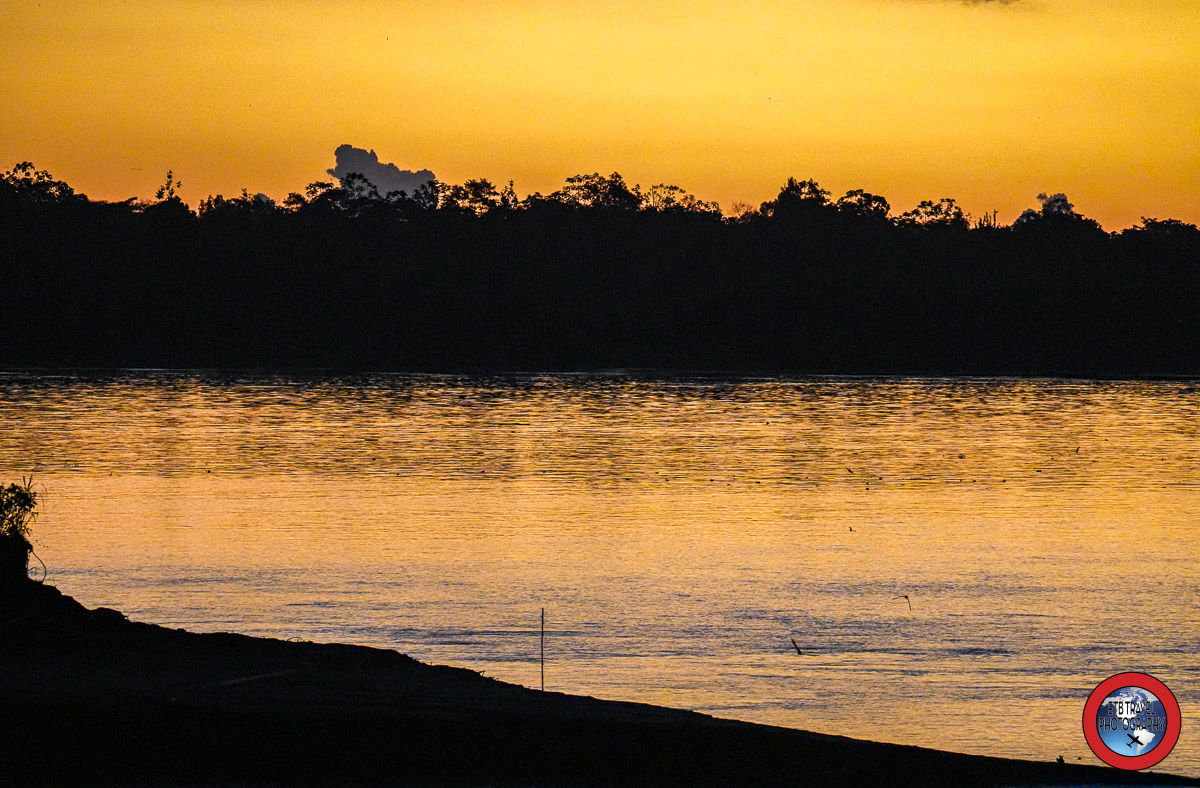
We stayed on the top deck to watch the sky turn from light blue to brilliant orange over the massive Peruvian Amazon before participating in a daily lecture and then eating a late dinner. We turned in early, as our morning skiff ride was planned for 6:30 am. ETB


We spent a few days in lodges along Amazon tributaries in both Peru and Brazil. The animals are obviously much the same, but we preferred our time in Brazil. It was surprisingly much more wild and less touristy, at least where we visited in both. But it was quite a few years between trips, so maybe its our memory too. Maggie
That’s good to know. I have some friends that did a riverboat in Brazil in February, and they were disappointed with how far away all the birds were (comparing to Africa). I can see how it would be less touristy though, which would be a plus. It felt like Peru is really pushing tourism. But my comparisons are from 15+ years ago at Machu Picchu and 20+ years ago at Iguazu Falls. And the Pantanal a few years pre COVID, but I feel like that area of Brazil is even less traveled.
We didn’t travel by a large boat in either. We stayed in jungle lodges so used small boats to travel which allows you to get closer to the animals. We also went to Bolivia’s Yacuma River which we really loved.
Good to know re Bolivia. Yes the boats use skiffs as well to get into narrower areas. Was better on the smaller rivers for sure
What an amazing experience on the amazon! 🙂
I guess it never really occured to me that you could visit the Amazon from Peru. Sounds like quite the journey to get there. And what a weird bird!